
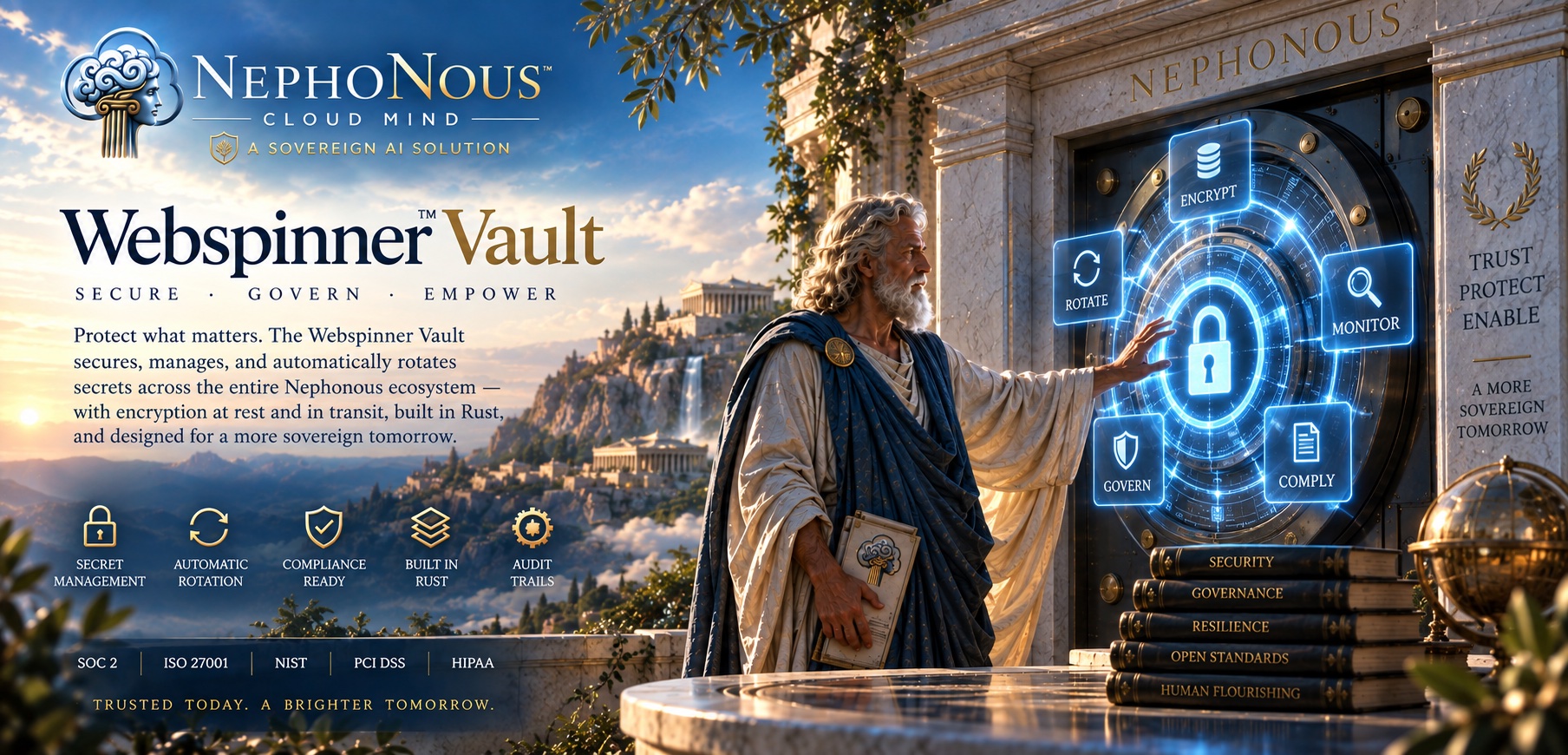
Sovereignty needs somewhere to keep the keys.
A sovereign system that leaks its credentials is not sovereign. The Vault holds every token the architecture needs on the same hardware the architecture runs on — released only to an identity that proved itself, and written to an audit log on the way past.
Credentials rot where you left them.
They accumulate in .env files, shell profiles and keychains on machines nobody
is auditing. Sharing one means copying it. Losing a laptop means rotating everything — if you
can remember what was on it. Owning your inference machine buys you nothing if the keys to it
are scattered across four laptops.
Who are you, and what may you have?
They are different questions, and the Vault refuses to let one answer stand in for the other.
Settled before the request arrives.
Every call reaches the Vault through Cloudflare Access, which gates it at the edge and injects a signed assertion. The Vault verifies that token against the team's public keys — audience, issuer and expiry — on every call.
A plaintext identity header is never trusted on its own. No valid token, no service.
Decided per secret, and default deny.
Each secret carries its own access list naming the identities that may read,
write or admin it. Admin implies write; write implies read.
Nothing is readable because it happens to exist.
There is no shared passphrase and no "the vault password." Every access resolves to a specific person or service token.
The disk alone is worth nothing.
Encrypted per record, keyed to one machine.
Every value is stored as an AES-256-GCM ciphertext with a unique random nonce for that record. Two secrets with the same value do not look alike on disk, and a copied database yields nothing without the master key.
That master key lives in the host's Keychain, which on Apple silicon is transparently wrapped by the Secure Enclave and scoped to that device. A stolen disk cannot carry the key off the machine it was made on — the same argument the inference architecture makes about your corpus, applied to the credentials that reach it.
Storing a value writes a new version rather than overwriting the old one, so a rotation can be verified and, if it went wrong, understood. Deleting tombstones the current version rather than erasing the record's history.
Every read is a row.
Not a log line that may or may not have been written — a record in the same database as the secret, made as part of serving it.
Who
The identity that asked, and whether it arrived as a person at the edge or as a service token. Attribution is not optional and cannot be turned off.
What
Which secret, which version, and what was attempted — read, write, delete, or a change to the access list itself.
From where
The address the call came from, recorded beside the identity, so a credential used from somewhere it has never been used before is visible rather than inferred.
And whether it worked
Refusals are recorded as carefully as grants. A denied read is the more interesting row of the two, and it is the one most systems throw away.
A single binary, and no ceremony.
The Vault is not a place people visit. It is something programs and scripts ask, in one line, and get an answer or a refusal.
# read a secret — the session is established once, at the edge
$ wsvault get webspinner-cf-token

# store a new version; the previous one stays queryable
$ wsvault put anthropic-api-key --kind anthropic_api_key

# what may this identity see?
$ wsvault list

# widen access deliberately, and leave a record of doing it
$ wsvault grant webspinner-cf-token --to contributors --permission read
Running, and honest about the rest.
The Vault has held this estate's credentials since April, on the same silicon that runs the inference. It is being made into something a patron can run on theirs — and this is the state of that work.
“Not a password manager. Not a cloud service. If the machine is down, the Vault is down.”
That last one is a decision, not a shortcoming. A credential store that stays reachable when your infrastructure is unreachable is a credential store somebody else is holding. This one holds machine credentials — API tokens, service secrets, database URIs — on hardware you can walk to. Human passwords belong somewhere else, and it declines to pretend otherwise.
Trust. Protect. Enable.