NephoNousCloud Mind · Sovereign AI
Proprietary
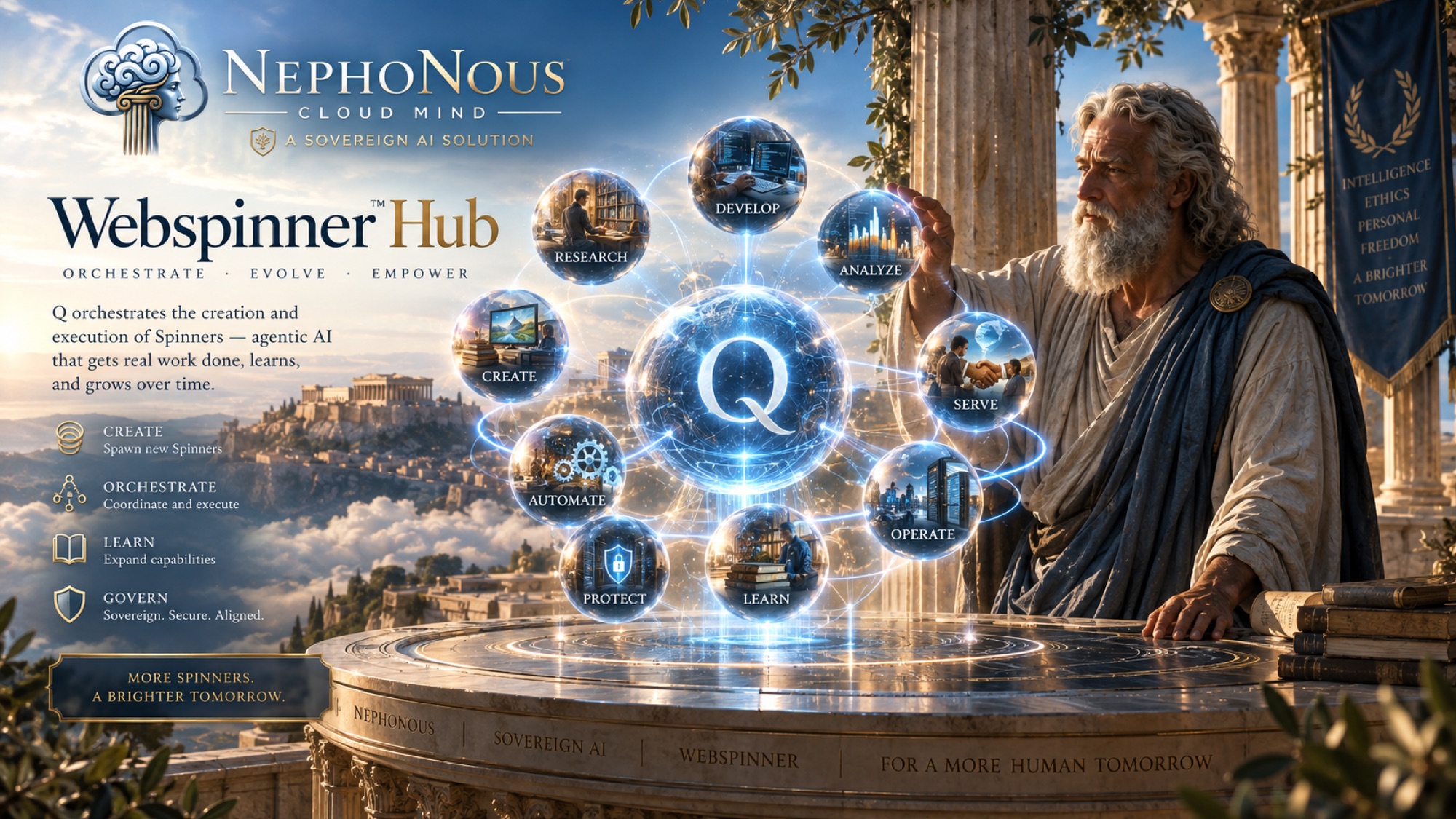
Q is the hub. Spinners do the work. You describe what you need in your own words, and Q creates, orchestrates and governs the capability — on hardware you already own.
Sovereign AI normally means giving something up — capability, or convenience, or a great deal of money. NephoNous exists because that trade is an artifact of how the hardware is arranged, not a law.
It runs on machines you own, in a room you can walk into. No tenancy, no jurisdiction you did not choose.
Your corpus and its index never leave your infrastructure. The inference node receives a passage, uses it within the turn, and keeps nothing.
Real work, not chat. Q reads your files, runs commands, searches your own material and carries out procedures you can add to.
Ordinary Apple silicon, distributed. Several inexpensive machines, arranged well, outrun one expensive one for this workload.
The hub does not accumulate features. It understands what you asked for, and reaches for the Spinner that does it — or makes one that does.
Spawn new Spinners. When you need something that does not exist yet, Q writes the procedure and you approve it. Nothing is rebuilt and nobody is called.
Coordinate and execute. One request may need a file read, a search of your own material and a command run. Q sequences them and answers from what actually came back.
Expand capabilities. Correct Q once and it holds the correction — on disk, in every future conversation, after a restart and after a rebuild.
Sovereign, secure, aligned. Anything that changes your machine is described to you and waits. The list of what is possible is fixed in compiled code, not decided by a model.
Q is an ontogenetic intelligence — an AI that grows its capabilities, knowledge and ontology through governed experience.
The word invites the wrong picture. A hub, as the industry uses it, is where source code is stored, branched and merged — a warehouse for artifacts. The Webspinner Hub is not that. What it holds and versions is intent: what you meant, what you asked for, what has to stay true. Spinners generate the executable from that intent, which makes the code a product of the record rather than the record itself.
The consequence is the part worth having. When intent is the source of truth, no code becomes a relic — there is no artifact quietly diverging from the reason it was written, because the artifact is regenerated from the reason. And requirements decay ends: requirements stop being a document that ages beside a system and become the thing the system is grown from.
That is what makes this AI Software Development Life Cycle ontogenetic — developing through an internal process of growth and differentiation, as an organism does, rather than being assembled once and thereafter defended against entropy. Not merely adaptive, which learns from experience without growing what it is; and not autopoietic, which would claim more than is true. Ontogenetic: Q develops its model of what exists, what things mean, how they relate, and what capabilities it can invoke or create.
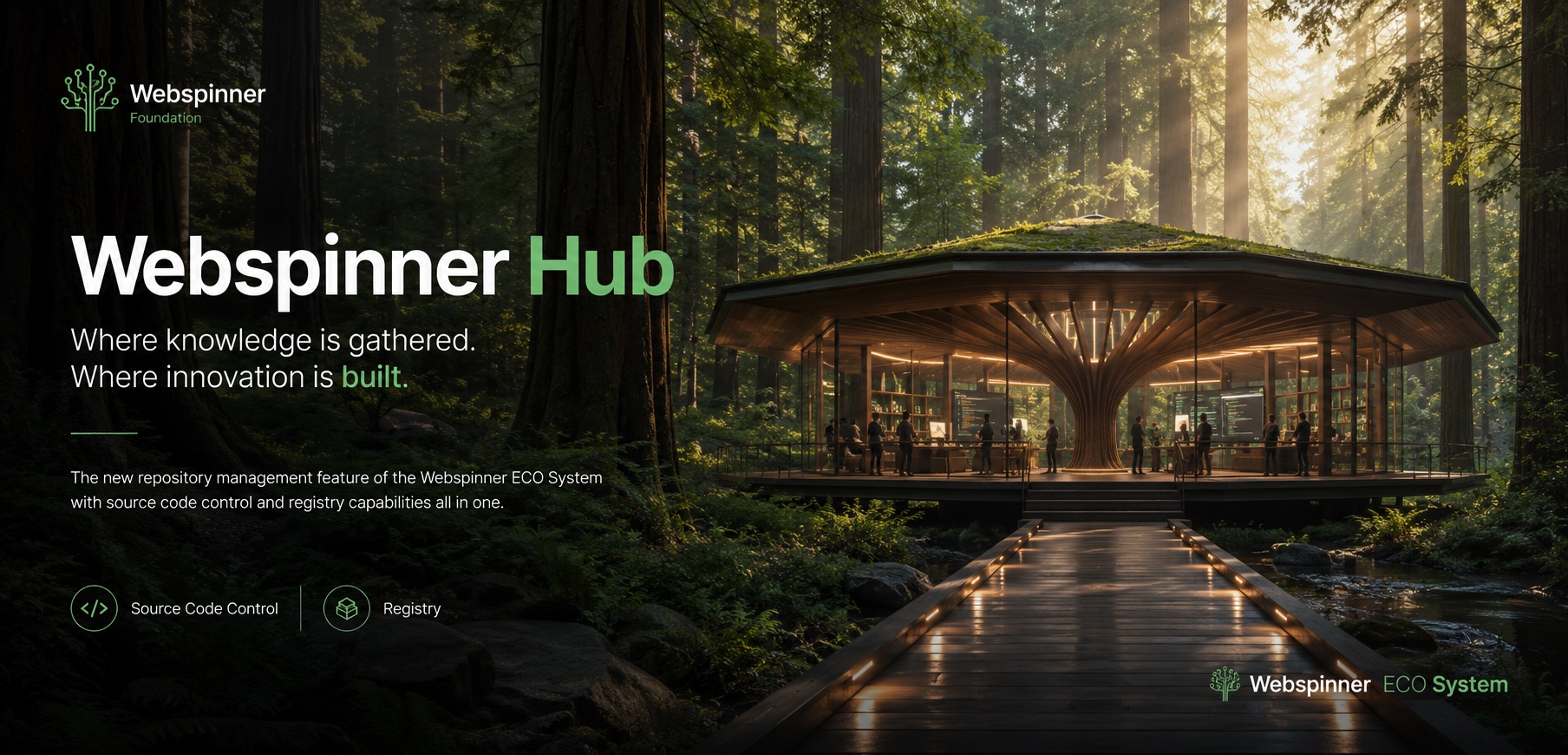
Not a warehouse of artifacts. The versioned record of what you meant — and every Spinner is grown from it.
webspinner.comEach one is a named purpose with a procedure behind it. Adding a Spinner adds an ability — no new version, no migration, no developer.
Search your own corpus and the public web, and answer with the source named.
Read a codebase, explain it, and work in it with real commands.
Turn files and records into a number you can act on, the same way every time.
Draft, compose and produce — with your own material as the ground.
Handle the work that faces other people, in your voice and under your rules.
Watch what is running, notice what stopped, and report it plainly.
Take the procedure you just worked out and keep it, so it runs itself next time.
Hold the boundary: what may run, what must ask first, what never runs at all.
Fold each conversation back in, so tomorrow starts where today finished.
Generative AI is superb at deciding what to do and unreliable at doing the same thing twice. So the work that must be identical every run is not left to it.
Written in prose. Cheap to add. Good at judgment.
A named purpose and a short procedure, in plain language. Q reads it when the moment calls for it and follows it.
Compiled programs. Typed in, typed out. Identical every run.
Real software — Swift or Rust — with a declared input and output. No model sits in the execution path, so the result is reproducible by construction.
The costly part of this workload is not generating words — it is reading everything you gave the model before it starts. NephoNous splits that work across machines you can actually afford: one holds the corpus, one does the thinking, one keeps the index, one carries the interface.
None of them has to be exceptional. The arrangement is what makes the whole capable, and the arrangement is the part that is designed.
It is also what makes privacy structural rather than promised: the node doing the thinking is handed a passage and keeps nothing, because there is nowhere in it for anything to stay.
“I know what I need done. I should not have to know how it is built.”
That is the whole design brief. Agentic AI has been the preserve of people who can write the tooling around it. The Hub exists so that the person who understands the work — not the framework — can direct it, extend it, and keep every byte of it at home.
More Spinners. A brighter tomorrow.