
An Apple-Shaped Niche

They looked for a supercomputer
and concluded there wasn't one.
That was never the unit of scale.

A trade press investigation found that AI is raising demand for Mac mini and Mac Studio without making the Mac into AI infrastructure. Its evidence is sound. Its conclusion assumes the only thing worth building is a cluster.

NephoNous scales the other way — not one large machine assembled from many, but many individually complete nodes, each retaining nothing.

Reading the MacStadium survey against a sovereign inference architecture · September 2026

PYLON
One gateway · many complete nodes · nothing retained
The Evidence

What the survey actually found

MacStadium surveyed roughly 300 US-based developers at mid-market and enterprise organisations that build for Apple platforms. The findings are the strongest public dataset on why Macs accumulate in racks.

0
Physical Macs on the average surveyed team — against a typical roster of only about 20 Apple-platform engineers.
MacStadium
0%
Of teams run 26 or more physical Macs purely for continuous integration and deployment.
MacStadium
0%
Report that adopting AI has increased their Mac infrastructure costs.
MacStadium
0%
Report more pull requests and commits since adopting AI coding tools. More code means more builds.
MacStadium
0%
Report excess build capacity. Only 6% report long queues. Supply is not the constraint.
MacStadium
0
A fully maxed Mac Studio, before taxes — with a 10 to 12 week lead time at the time of writing.
AppleInsider

Nearly half already run open weights

"Which best describes how your organization runs AI workloads related to software development?"

Primarily hosted AI services (OpenAI, Anthropic, etc.)36%
Primarily self-hosted open-weight or private models24%
A mix of hosted and self-hosted models23%
Still evaluating options17%
47% already run at least some self-hosted or open-weight model. That is not a rounding error at the edge of the market — it is nearly half of a population that was selected for building on Apple platforms, and it is the population for whom sovereignty is not an abstraction. A further 17% have not chosen yet.
"There's an entire ocean between 'AI is driving Mac demand' and 'Mac is becoming foundational AI infrastructure.'"
AppleInsider · 31 August 2026
Where We Agree, and Where We Part

The ocean is real. It is also beside the point.

Every factual claim in that argument holds. The inference drawn from it — that there is therefore no serious Apple-silicon infrastructure story — depends on one unexamined assumption about what infrastructure means.

The Cluster Assumption

Infrastructure means one large machine

  • Scale is achieved by lashing many devices into a single fabric, and judged by how well they behave as one.
  • Apple silicon interconnect is not built for this. It will not displace purpose-built accelerators at that game.
  • Multi-Mac model spanning exists — EXO Labs, Mount Thor's neocloud — but the article fairly calls these niche.
  • Apple's own answer confirms the frame: for Private Cloud Compute it purpose-builds servers around its own chips, and declines to sell them.
  • Conclusion drawn: the Mac is a developer tool that AI made busier, not infrastructure.
The NephoNous Position

Infrastructure means a unit that is complete

  • The unit of scale is one node that can serve a turn end to end — hold the weights, run prefill, decode, and retain nothing.
  • Nothing needs to span machines, so the interconnect ceiling that ends the cluster argument never binds.
  • Unified memory is the enabling property, not a consolation: one pool the CPU and GPU both address, sized to hold a real model.
  • Scale is horizontal and embarrassingly parallel — add a node, serve more patrons. A gateway routes; it does not federate a computation.
  • Conclusion drawn: the Apple-shaped niche the article identifies is precisely the shape of a sovereign node.
Illustration I

Two roads out of the same constraint

Two architectures compared: the purpose-built accelerator hall and the federation of complete nodes.
Image2 · Pending

The Accelerator Hall and the Federation

A diptych in the NephoNous idiom: on the left a vast purpose-built hall of racked accelerators under a cold sky; on the right a colonnade of individually complete marble nodes, each self-contained, each luminous, under the same sky.

assets/fig-1-two-roads.png

The article is right that the left-hand road is closed to Apple silicon. NephoNous does not take it.

The Unit of Scale

One complete node. Nothing retained.

The architecture is named in Greek from the gateway inward. What follows is the same anatomy the white paper sets out, read specifically as it lands on owned Mac hardware.

Outside the node NephoNous services Owned hardware
ThesaurosPatron-held corpus

The corpus and its vector index never leave the patron's own infrastructure. The node borrows passages by Anaklesis and gives them back. Residency, here, is not a claim about a jurisdiction — it is a claim about which machine holds the file.

SyrinxOutbound-only tunnel

The node dials out. Nothing dials in. On a Mac in a rack this is the whole ingress story — no inbound port, no listening surface, no exposed origin.

PylonIdentity, quota, assembly

The gateway. It authenticates the patron, meters the turn, assembles the prompt from borrowed passages — and, critically, decides which node already holds the prefill for this context.

OikeiosisAffinity routing

Affinity is the economic heart of the design. Route a patron to the node that has already computed their context and the expensive part of the turn simply does not happen again.

MonasThe complete node · Katharsis

One Mac. Unified memory holds the weights and the working context in a single pool the CPU and GPU both address. Katharsis is the guarantee that when the turn ends the node keeps nothing — the property from which sovereignty follows.

MonothyrosSingle-threaded metal gate

One turn at a time through the metal. Determinism over throughput: a node that never contends with itself is a node whose latency can be reasoned about.

Cache TierThemelion · Mneme · Anamnesis

Where the moat is dug. Prefill computed once and recalled rather than recomputed. The article's own framing — that the cost is in the waiting — is the cost this tier attacks.

Model WeightsHomoousia · local NVMe

Of one substance with the node. Weights sit on the machine's own storage, loaded into the same memory pool that serves the turn.

Everything inside this boundary is owned hardware — and holds nothing once the turn ends.
Illustration II

The Monas, in owned hardware

The Monas node rendered as owned Apple hardware within the classical architecture.
Image2 · Pending

One Complete Node

The jade-lit Monas enclosure of the master diagram, opened to show what it actually is: a single Mac Studio seated on the marble plinth, its unified memory rendered as one luminous pool feeding weights, cache and decode together.

assets/fig-2-monas-mac.png

Katharsis is a property of this box: when the turn ends, what it held is gone.

The Scaling Arithmetic

How the federation grows

Because nothing spans machines, the sizing question is small enough to hold in the hand: what must fit in one node's memory, and how many nodes does the patron load require. Move the controls.

How this is computed. Weights are bytes-per-parameter times parameter count. The KV cache is estimated per thousand tokens and scales with model width. A third is added for the runtime, the OS and a working cache tier, and the result is rounded up to the nearest unified-memory configuration Apple actually ships. Node count assumes no affinity hit at all — every context computed from cold. It is a floor, deliberately.
Weights resident18GB
KV cache per turn2.1GB
Minimum unified memory36GB
Nodes in the federation6
Turns served per hour1,440
One gateway · 4 complete nodes

A sizing model, not a quotation. Throughput per node is expressed as a tunable service rate rather than a benchmark claim, because the honest number depends on the model, the silicon generation and the prefill hit rate — and the last of those is the one NephoNous exists to change.

Illustration III

One gateway. Many complete nodes.

The federation: one Pylon gateway routing to a colonnade of complete Mac nodes.
Image2 · Pending

The Federation

The Pylon gateway raised above a wide colonnade of identical jade-lit Monas nodes receding into cloud — each complete, none dependent on its neighbour. Gold light of affinity routing falls on the node that already holds the patron's context.

assets/fig-3-federation.png

Horizontal by construction. A node is added the way a column is added to a colonnade — the building does not need rebuilding.

Why This Substrate

Prefill is where the money is

The article observes that these machines suit "hyper-specific use cases that require a lot of repetition." That is a more precise description of retrieval-augmented inference than it may have intended.
The Claim NephoNous Makes

Compute it once. Never again.

  • In retrieval-augmented work the dominant latency is prefill — reading the context before the first token is emitted. The patron is paying to wait.
  • Affinity routing plus a resident cache tier turns a repeated context from a recomputation into a recall.
  • This is the cost the industry has attacked least on this substrate, which is what makes it defensible rather than merely clever.
  • Unified memory is why it lands here: the cache and the weights occupy the same pool, so recall is not a transfer across a bus.
Why Owned, Not Rented

The unit economics invert

  • Metered inference is a variable cost that scales with success. Owned capacity is a depreciating fixed asset with negligible marginal cost per turn.
  • The survey's finding that 21% already hold excess build capacity describes hardware that is bought, racked, and idle between builds.
  • Energy efficiency per unit of work is the property that makes a small owned fleet viable where a rented one would not be.
  • And the node that keeps nothing cannot leak what it never held — a compliance posture that survives the operator, not one that depends on trusting them.
Illustration IV

The cache tier

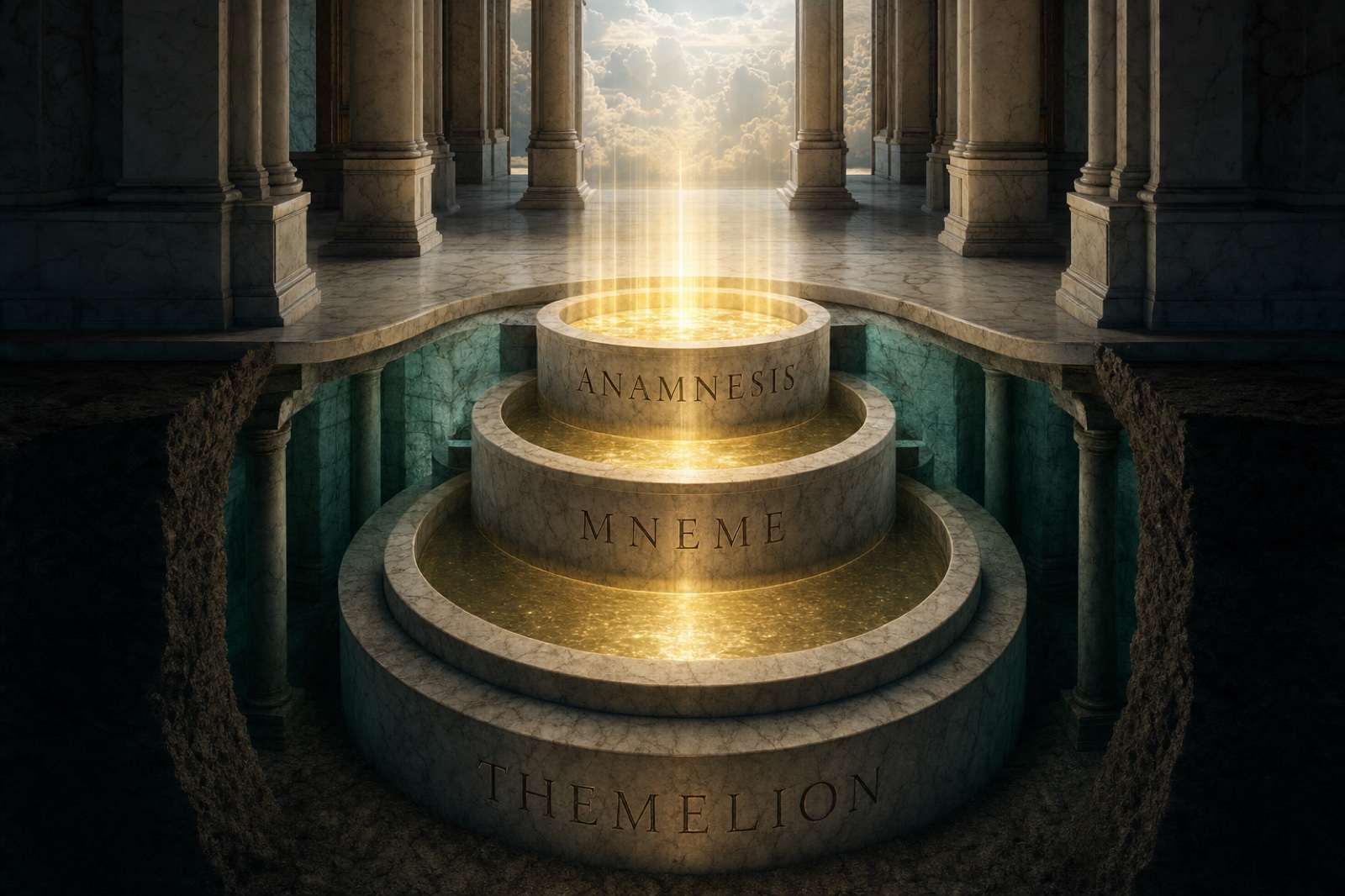
The cache tier: Themelion, Mneme and Anamnesis rendered as a classical cistern.
Image2 · Pending

Themelion · Mneme · Anamnesis

The three-stage cache as a classical cistern beneath the node — foundation, memory and recollection as descending marble basins, one filling the next, gold light rising back up rather than pouring in again.

assets/fig-4-prefill-moat.png

The moat is not the model. It is everything the node no longer has to do twice.

Stated Plainly

Where this does not apply

The white paper's discipline is to say where the argument stops. The same discipline applies to reading a survey in one's own favour.

Four honest limits

  • Training is not this. Nothing here addresses training or fine-tuning at scale. The article's judgement that Apple silicon will not displace purpose-built accelerators for that work stands unchallenged, because NephoNous does not contest it.
  • The survey has selection bias, and its authors say so. MacStadium polled infrastructure professionals at organisations that build software for Apple platforms. That population is unrepresentative of software generally — it is, however, precisely the population that already owns Macs in quantity.
  • Bulk purchasing is not an endorsement. That OpenAI has bought tens of thousands of Macs and Anthropic leases minis through AWS is reported as CI, reinforcement-learning loops and teaching models to drive macOS. It is evidence that the hardware earns its place in a pipeline, not evidence that anyone is running frontier inference on it.
  • A single node has a ceiling. A model that will not fit one machine's unified memory is out of scope by construction. Multi-Mac spanning exists and is real work, but it is not the NephoNous design — completeness of the node is the premise the whole sovereignty argument rests on.
Attribution

Every figure, to a named source