
NephoNousCloud Mind · Sovereign AI
Proprietary
A trade press investigation found that AI is raising demand for Mac mini and Mac Studio without making the Mac into AI infrastructure. Its evidence is sound. Its conclusion assumes the only thing worth building is a cluster.
NephoNous scales the other way — not one large machine assembled from many, but many individually complete nodes, each retaining nothing.
Reading the MacStadium survey against a sovereign inference architecture · September 2026
MacStadium surveyed roughly 300 US-based developers at mid-market and enterprise organisations that build for Apple platforms. The findings are the strongest public dataset on why Macs accumulate in racks.
"Which best describes how your organization runs AI workloads related to software development?"
Every factual claim in that argument holds. The inference drawn from it — that there is therefore no serious Apple-silicon infrastructure story — depends on one unexamined assumption about what infrastructure means.

A diptych in the NephoNous idiom: on the left a vast purpose-built hall of racked accelerators under a cold sky; on the right a colonnade of individually complete marble nodes, each self-contained, each luminous, under the same sky.
assets/fig-1-two-roads.png
The article is right that the left-hand road is closed to Apple silicon. NephoNous does not take it.
The architecture is named in Greek from the gateway inward. What follows is the same anatomy the white paper sets out, read specifically as it lands on owned Mac hardware.
The corpus and its vector index never leave the patron's own infrastructure. The node borrows passages by Anaklesis and gives them back. Residency, here, is not a claim about a jurisdiction — it is a claim about which machine holds the file.
The node dials out. Nothing dials in. On a Mac in a rack this is the whole ingress story — no inbound port, no listening surface, no exposed origin.
The gateway. It authenticates the patron, meters the turn, assembles the prompt from borrowed passages — and, critically, decides which node already holds the prefill for this context.
Affinity is the economic heart of the design. Route a patron to the node that has already computed their context and the expensive part of the turn simply does not happen again.
One Mac. Unified memory holds the weights and the working context in a single pool the CPU and GPU both address. Katharsis is the guarantee that when the turn ends the node keeps nothing — the property from which sovereignty follows.
One turn at a time through the metal. Determinism over throughput: a node that never contends with itself is a node whose latency can be reasoned about.
Where the moat is dug. Prefill computed once and recalled rather than recomputed. The article's own framing — that the cost is in the waiting — is the cost this tier attacks.
Of one substance with the node. Weights sit on the machine's own storage, loaded into the same memory pool that serves the turn.

The jade-lit Monas enclosure of the master diagram, opened to show what it actually is: a single Mac Studio seated on the marble plinth, its unified memory rendered as one luminous pool feeding weights, cache and decode together.
assets/fig-2-monas-mac.png
Katharsis is a property of this box: when the turn ends, what it held is gone.
Because nothing spans machines, the sizing question is small enough to hold in the hand: what must fit in one node's memory, and how many nodes does the patron load require. Move the controls.
A sizing model, not a quotation. Throughput per node is expressed as a tunable service rate rather than a benchmark claim, because the honest number depends on the model, the silicon generation and the prefill hit rate — and the last of those is the one NephoNous exists to change.

The Pylon gateway raised above a wide colonnade of identical jade-lit Monas nodes receding into cloud — each complete, none dependent on its neighbour. Gold light of affinity routing falls on the node that already holds the patron's context.
assets/fig-3-federation.png
Horizontal by construction. A node is added the way a column is added to a colonnade — the building does not need rebuilding.
The article observes that these machines suit "hyper-specific use cases that require a lot of repetition." That is a more precise description of retrieval-augmented inference than it may have intended.
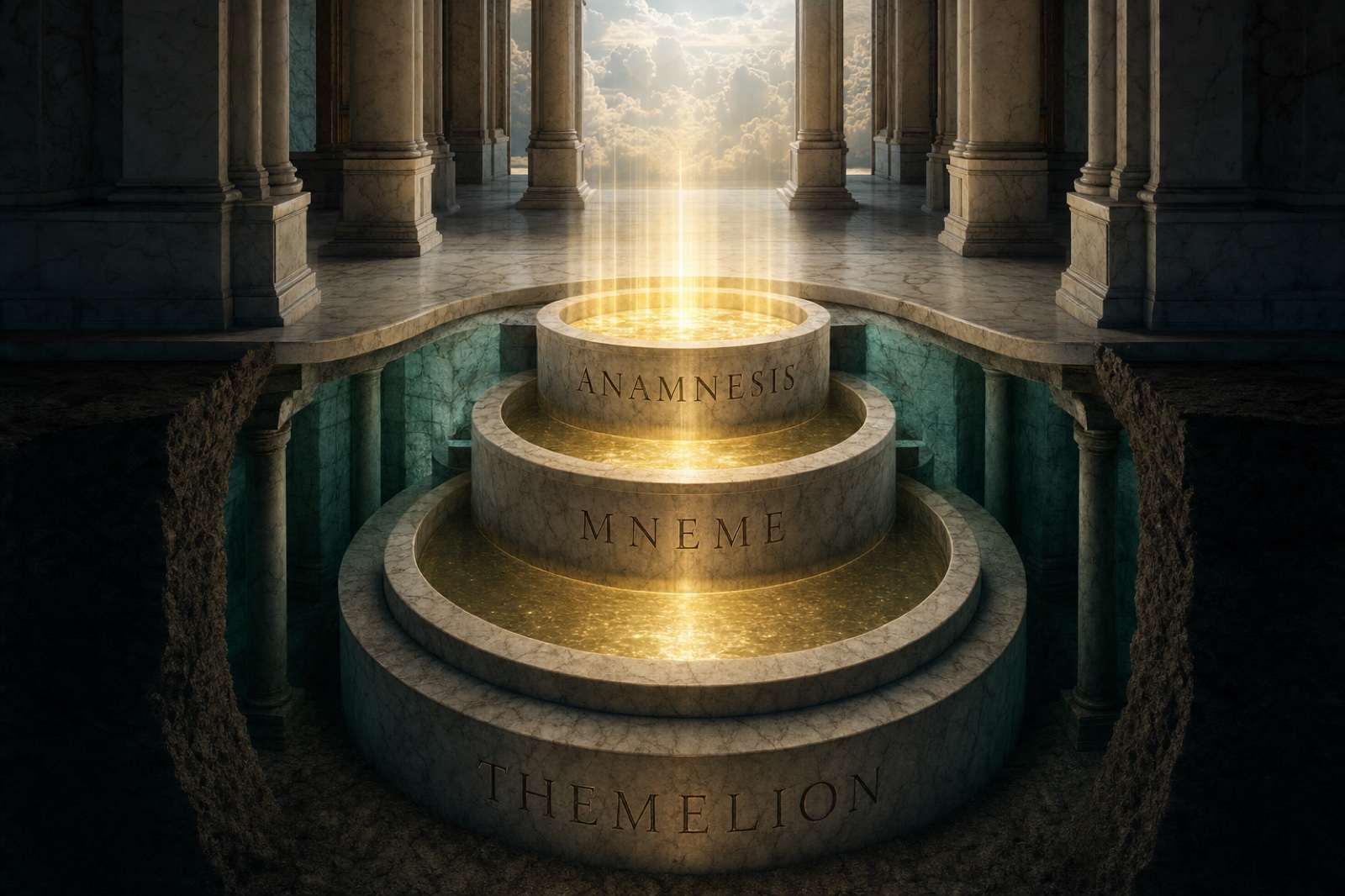
The three-stage cache as a classical cistern beneath the node — foundation, memory and recollection as descending marble basins, one filling the next, gold light rising back up rather than pouring in again.
assets/fig-4-prefill-moat.png
The moat is not the model. It is everything the node no longer has to do twice.
The white paper's discipline is to say where the argument stops. The same discipline applies to reading a survey in one's own favour.